More and more government services are being offered digitally. This is convenient for both citizens and service providers: information is quickly accessible and many processes become more efficient. But every web page that is loaded also consumes energy. And while the government, together with implementing organizations, is working on more sustainable IT provisions, the energy impact of government websites largely remains out of view.
To gain better insight into this, we analyzed the entire Register of Government Organizations and measured the energy consumption of 1150 Dutch government websites. This allows us to identify which websites are efficient, which unnecessarily consume large amounts of energy, and where the greatest opportunities lie to reduce digital energy use.
How we measure
We conduct these kinds of measurements in our Software Energy Lab at the Radboud University. In this lab we study the energy consumption of software under controlled conditions—from websites to algorithms and AI applications. Among other things, we use specialized measurement equipment that accurately records how much energy a computer consumes, for example while loading a web page. This allows us to reliably compare websites with one another.
What we found
Most government websites turn out to be relatively energy-efficient. That is good news: many sites are simply structured and contain few heavy elements such as multimedia, scripts, or interactive components. However, we also see some significant outliers. Around one hundred websites consume two to as much as ten times more energy than the average. Compared to the most efficient websites, this difference even rises to almost a factor of 100. There is clearly still much to gain.
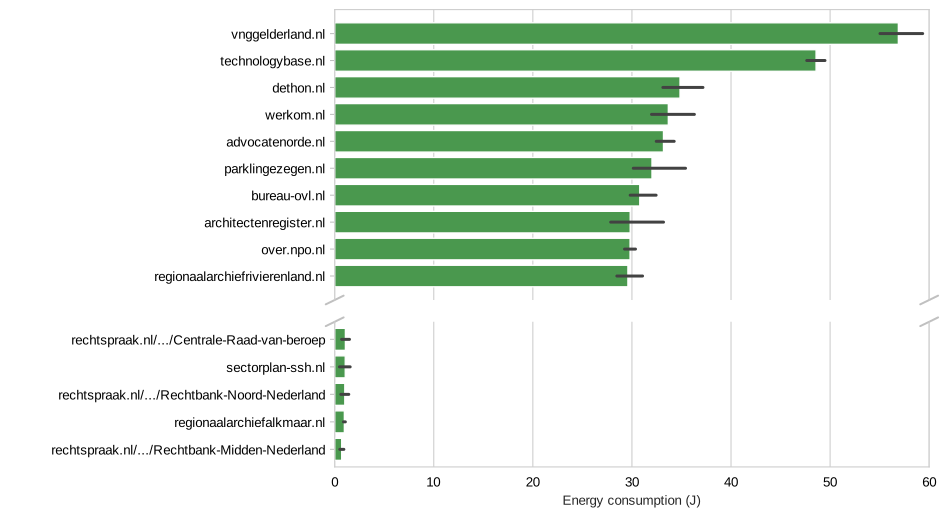
When we look at the top 10 most energy-intensive websites, one thing immediately stands out: when these pages load, a video or animation starts automatically. This may look appealing, but it requires a lot of computing power from the visitor’s laptop or phone. This leads to unnecessarily high energy consumption and also causes the battery to drain more quickly.

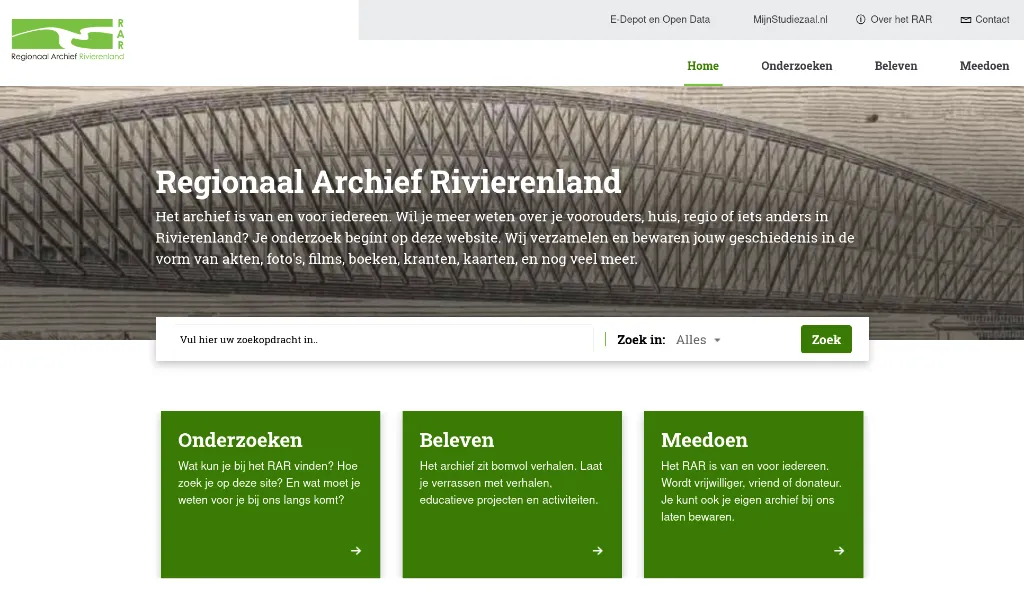
One notable outlier is the Regional Archive Rivierenland. The website looks simple and at first glance does not contain large animations or heavy components, yet it still ends up in the top 10. When we scroll further down the homepage we quickly see why: at the bottom of the page there are several embedded YouTube videos and Spotify podcasts. This means the page not only loads noticeably slower, but also continuously consumes energy for media elements that many visitors probably never even see or use.
Saving energy
The high energy consumption of these websites is not necessary. In many cases, simple adjustments can already lead to major improvements, such as:
- Not playing animations and videos automatically.
- Loading media only when a user actively clicks on it.
- Removing unnecessary scripts, plug-ins, and trackers.
- Optimizing and compressing images.
In practice, many visitors stay on the homepage only briefly and quickly click through to the information or service they are looking for. Heavy media elements on this page therefore often add little value, but do cause additional energy consumption with every visit. In many cases, a simple and lightweight homepage is therefore the best choice.
Potential energy savings
We see that about 400 websites have above-average energy consumption. This raises the question of how much energy could be saved if these websites were designed more efficiently. To get an idea of this, we estimate the annual energy use of these websites. In doing so, we look not only at the energy consumption of a single page load, but also at how often and how long websites are visited. For a rough estimate we therefore use a number of conservative assumptions. We assume that an average government website receives about 50,000 visits per year and that a visit lasts five minutes on average.
With these assumptions, we see that simple optimizations across these 400 websites together could lead to savings equivalent to about 130,000 mobile phone charges. In this calculation we only look at the energy consumption on the visitor’s device. The energy use of servers and network traffic is not yet included. If we were to include the full lifecycle, the real impact would be considerably higher.
A shared language
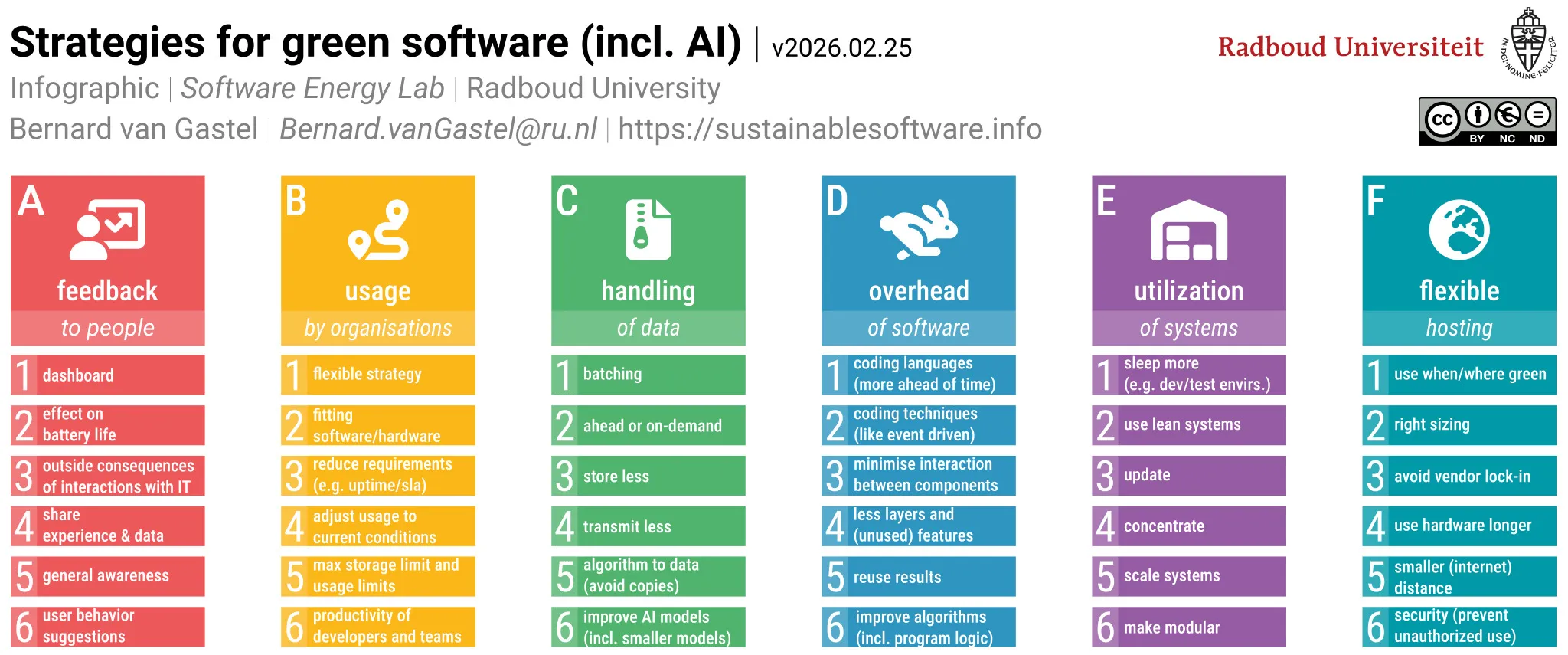
To help organizations implement these improvements not only technically but also organizationally, we developed a visual conversation guide with concrete strategies for sustainable software. This guide provides a shared language that improves communication between policymakers, developers, designers, and suppliers. By presenting strategies in a clear overview, it becomes easier to have internal discussions, determine priorities, and structurally integrate sustainable choices into the development process. In this way, organizations can take faster and more effective steps toward a more energy-efficient digital government.
Join us
Making government websites more sustainable does not require large investments, but rather attention and conscious choices based on measurements. Are you involved with a government organization yourself, or do you manage a website? Then take a critical look at the pages you publish. Low-hanging fruit and small adjustments can already make a noticeable difference in both energy consumption and user experience.
Would you like to know how your website scores, or explore together where optimizations are possible? Feel free to contact us via TODO.